
By the Sagecare care team | Medically reviewed by Navkiran Dhesi, RN, Sagecare | Last updated October 15, 2026

Delirium vs Dementia At a Glance
● Delirium is a sudden, severe change in thinking and alertness that develops over hours or a day or two, while dementia develops over months and years.
● Delirium is usually caused by something treatable, most often an infection, dehydration, a new medication, pain or a hospital stay.
● People living with dementia are far more likely to develop delirium, and in them it's easy to mistake for the dementia getting worse.
● The warning sign is speed. If a loved one is much more confused, sleepier or more agitated than they were yesterday, treat it as a medical problem the same day.
● Most delirium improves within days once the cause is treated, though some people take weeks or months to return to their usual selves.
Delirium is a sudden and severe disturbance in thinking that changes a person's ability to stay alert, remember, know where they are and speak or reason clearly. Dementia is a gradual decline in memory and thinking that unfolds over years. The two can look identical on a bad afternoon, and the difference between them can decide whether a family calls a doctor today or waits.
Most families who come to our home have lived through at least one of these afternoons. A mother who was chatting on Sunday can't follow a sentence on Tuesday. A father who has cooked in the same kitchen for forty years suddenly doesn't recognize it. The instinct is to assume the dementia has taken a step down, but often it hasn't, and often something else is wrong that can be fixed.
At Sagecare, we believe careful observation is the beginning of understanding, and this guide is about what to observe. It explains how delirium differs from dementia, what tends to trigger it, what to do in the first hours and how a memory care home watches for it every day.
How Delirium Differs From Dementia
The Canadian Coalition for Seniors' Mental Health puts the distinction in one line: delirium can look like dementia, but the difference is that delirium comes on quickly. Everything else about telling them apart follows from that.
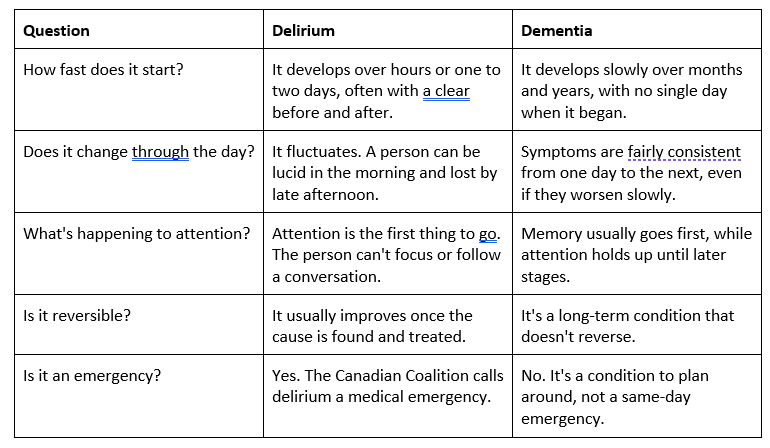
The complication is that the two often travel together. The Alzheimer's Society names dementia as the biggest single risk factor for delirium, and Harvard Medical School reports that delirium affects up to half of older adults in hospital. When delirium lands on top of dementia, families and even hospital staff can read it as the disease progressing, and the treatable cause goes unfound.
What Triggers Delirium in a Person With Dementia
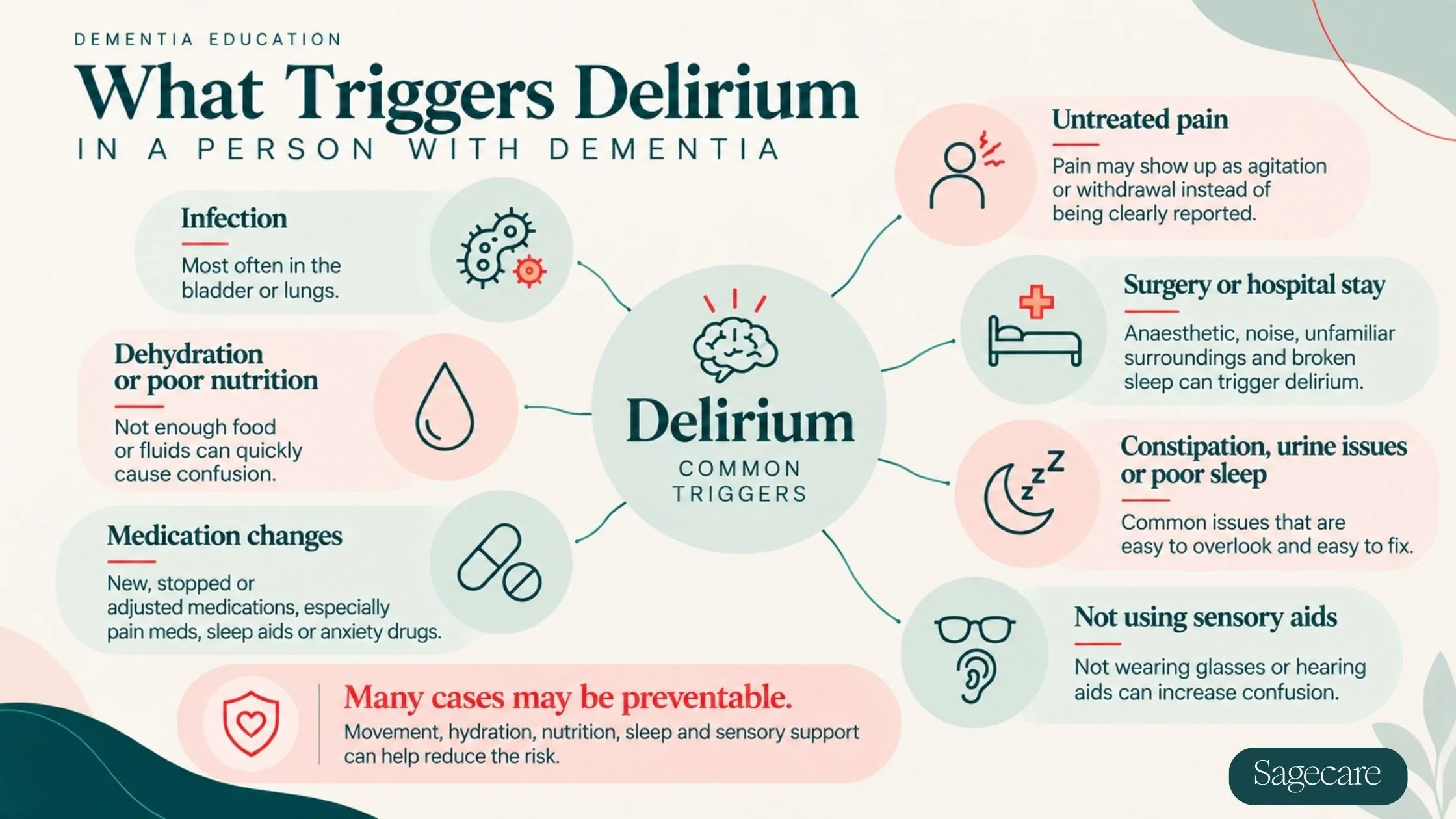
Delirium is almost never caused by one thing alone. The Canadian Coalition describes it as a mix of factors, and in a person whose brain is already vulnerable, a small setback can be enough. The common triggers it lists are:
● An infection, most often in the bladder or the lungs. A urinary tract infection is the classic cause of sudden confusion in an older adult, and in someone with dementia it often shows up as confusion with no fever at all.
● Not eating well or not drinking enough water. Dehydration lowers blood pressure and thickens the blood, and confusion is one of its first signs in older adults. We covered the daily side of this in our guide to dehydration and dementia.
● Starting, stopping or changing the dose of a medication, especially pain medication, sleep aids and drugs for anxiety.
● Untreated pain. A person with dementia may not be able to say that a hip or a tooth hurts, so the pain shows up as agitation or withdrawal instead. Our guide to pain management in dementia covers the quieter signs.
● Surgery, anaesthetic and the disorientation of a hospital ward, with its noise, unfamiliar faces and broken sleep.
● Constipation, difficulty passing urine and poor sleep, which are easy to overlook and easy to fix.
● Not wearing glasses or hearing aids, which cuts a person off from the cues that keep them oriented. We look at this more closely in our article on hearing loss and dementia.
Notice how ordinary these are. That's the hopeful part, because ordinary causes can often be prevented, and Harvard's delirium researchers note that many cases can be prevented with steady attention to movement, food, fluids, sleep, glasses and hearing aids.
The Warning Signs Families Notice First
The Canadian Coalition for Seniors' Mental Health advises families to see or talk to a healthcare provider right away if any of these appear suddenly, even if they come and go:
● Trouble paying attention, being distracted or unable to follow a conversation.
● Saying or doing things that don't make sense.
● Hearing voices or seeing things that other people don't.
● Developing strange beliefs, such as thinking people are trying to cause harm.
● Being withdrawn, quieter or slower than usual, or the opposite: restless, worried, annoyed or angry.
● Trouble staying awake during the day, or not sleeping at night.
Two of these signs deserve a closer look, because they're the ones families most often miss. The first is that delirium isn't always loud. The Alzheimer's Society describes a hypoactive form in which the person becomes sleepy, sluggish and withdrawn instead of agitated. A parent who "just seems tired" and stops talking may be as unwell as one who is pacing and shouting, and the quiet version is the one that gets overlooked.
The second is the pattern of coming and going. A person with delirium can seem almost themselves at breakfast and be frightened and confused by dinner, and families sometimes take the good morning as proof that nothing is wrong. With delirium, the swing itself is the symptom. It's also different from sundowning, the late-day restlessness many people with dementia experience. Sundowning follows a pattern families come to recognize over time. Delirium is new, and it arrives suddenly.
What to Do in the First 24 Hours
Sudden confusion in a person with dementia is a medical problem until proven otherwise.
Call 9-1-1 right away if your loved one can't be woken or is very hard to rouse, is having trouble breathing, has chest pain, has fallen or hit their head, or shows signs of a stroke, such as a drooping face, weakness in an arm or slurred speech.
For everything short of that, these are the steps that make the biggest difference.
● Call the doctor the same day, or go to urgent care or the emergency department if the person seems very unwell, can't keep fluids down or appears to be in pain. Tell them the change was sudden, because that single word changes how they assess it.
● Write down when it started and what changed. The Alzheimer's Society recommends noting the onset and the shifts through the day, because a clear timeline is the fastest route to the right diagnosis.
● Bring the medication list, including anything started or stopped in the past two weeks.
● Offer fluids in small, frequent sips while you wait, unless the person has trouble swallowing.
● Stay close. The Canadian Coalition advises families to remain with the person whenever possible, especially in the evening and overnight, and to speak softly, one short idea at a time.
● Don't argue with what they're seeing or believing. What the person is experiencing is real to them. Reassure them, gently redirect the conversation and move on. Our guide to communication techniques for dementia caregivers has more on validating rather than correcting.
If the cause is an infection, the confusion usually begins to lift within a few days of treatment. If a medication is to blame, stopping it or lowering the dose often does the same. Recovery isn't always quick, though. The Alzheimer's Society notes that some people take weeks or even months to return to where they were, and some don't fully recover, which is one more reason to act early rather than wait it out.
Why Delirium Matters So Much in Dementia Care
An episode of delirium is not a footnote. Harvard researchers report that when delirium occurs in people with dementia, cognitive decline accelerates, and they're studying whether the delirium itself causes lasting changes in the brain.
Every avoided episode protects ground that's hard to win back, which is why good dementia care is, in large part, delirium prevention: regular meals and fluids, a steady sleep routine, daily movement, glasses and hearing aids within reach, pain that gets noticed and treated, and medications reviewed rather than quietly accumulating.
None of it is dramatic, and all of it is what dementia care services should deliver, hour by hour. It's also the same attention that keeps managing dementia behaviours from turning into a crisis.
The other half of prevention is knowing the person. Delirium is only visible against a baseline, and a caregiver who knows how someone normally speaks, walks and eats will notice the shift on the first morning rather than the third. That knowledge is the heart of person-centred dementia care, and it's why a familiar care team catches changes early. It's the same way a family knows when a grandmother isn't quite herself at Sunday dinner, and it's the kind of attention we believe every elder deserves.

When Sudden Confusion Points to a Bigger Conversation
Sometimes an episode of delirium is the moment a family realizes how thin the margin at home has become. Perhaps an infection went unnoticed for a few days, or no one could be there often enough to see that a parent had stopped drinking water, or a medication change was hard to keep track of across several doctors.
None of this happens because a family doesn't care. It happens because one or two people can't watch over someone around the clock, and no one should expect them to.
What an episode like this offers is information, not a verdict. If it showed you how much watching a loved one now needs, our guide to when a loved one is no longer safe at home can help you think it through calmly, before the next emergency makes the decision for you.
Frequently Asked Questions
What is the main difference between delirium and dementia?
Speed is the clearest difference. Delirium arrives over hours or a day or two and tends to come and go through the day, while dementia changes slowly over months and years. Delirium usually has a cause that can be found and treated, such as an infection, dehydration or a new medication, whereas dementia is a long-term condition. Because the two can happen together, a person with dementia who suddenly seems much worse should be seen by a doctor that day, with delirium in mind.
Can a urinary tract infection cause confusion in someone with dementia?
Yes. A urinary tract infection is one of the most common reasons an older adult becomes suddenly confused, and in people living with dementia it often arrives without the burning, urgency or fever a younger adult would notice. Instead, families see agitation, drowsiness, new stumbles or a sharp change in behaviour. A urine test can confirm it, and once antibiotics begin, the confusion usually starts to ease within a few days.
How long does delirium last in the elderly?
For many older adults, delirium begins to clear within a few days of the cause being treated. For others, especially people already living with dementia, recovery can stretch over weeks or months, and not everyone returns fully to how they were before. How quickly the cause is found makes a real difference, and so does recovering somewhere calm and familiar, surrounded by people the person knows.
Can delirium be prevented in a person with dementia?
Often, yes. Most prevention comes down to the basics, done consistently: enough to drink, good meals, movement every day, sleep at night, glasses and hearing aids in use, pain treated, and medications reviewed regularly by a doctor or pharmacist, as the Canadian Coalition for Seniors' Mental Health recommends. The hard part at home is doing all of it, every day. In a memory care home, these are simply the rhythm of the day, and a team that knows each resident can spot a small change before it becomes an episode.
Does delirium make dementia worse?
It can. An episode of delirium can speed up the decline in memory and thinking for someone living with dementia, and scientists are still working out exactly why. Plenty of people do get back to where they were once the cause is treated, but not everyone does. That's why prevention matters so much, and why a sudden change always deserves a same-day response rather than a wait-and-see approach.
How Sagecare Watches for Delirium Every Day
Delirium is only visible to someone who knows what normal looks like. At Sagecare, elders are cared for by registered nurses and care specialists who come to know each resident like family: how they take their tea, how they walk down the hall, what a good morning sounds like. Our high staff-to-resident ratio gives them the time to notice when something shifts, so a quieter morning or an untouched glass of water is noticed and acted on the same day.
Meals, fluids, sleep, movement and medications are part of a steady routine in a home-like setting, which is exactly what prevents many episodes in the first place. And when something does change, the people who notice are people who know and love the person in front of them.
If your family has just been through a frightening few days of sudden confusion and you'd like to talk about what it might mean, Sagecare is here to listen. Talk with our care team, and when you're ready, book a tour of our home on Elder Street in North York. Every member of our community is well-known, honoured, respected and loved, and that starts with the first conversation.